
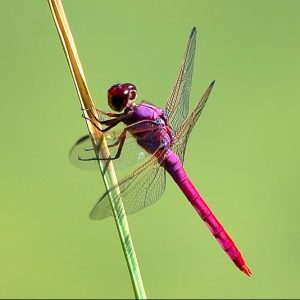
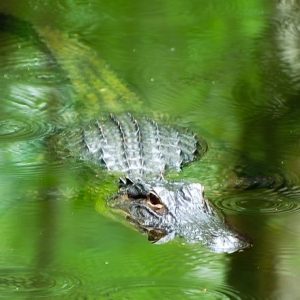
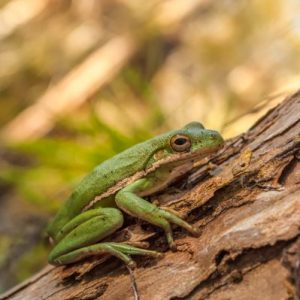
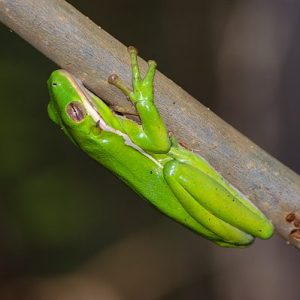
Today I had a sudden urge to get away from my office, away from photo editing, away from working on web-related photo projects and just had to get into the woods, despite the heat and humidity. I loaded up my mountain bike for light and fast travel, chose my Nikon 70-300mm VR for a simple yet very sharp zoom lens, and popped on my Nikon D2X body and hit the trails of Elinor Knapp Phipps Park. Just outside of the city limits of Tallahassee, this pleasantly maintained park borders Lake Jackson – a large and interesting lake that I frequent regularly and is a perfect place for birding, wildflowers, and is a particularly good location for finding butterflies.
One of my favorite things about quick, sudden trips is going light – meaning one lens, one camera, no other gear. It forces me to see things a certain way, and often instead of suddenly wishing I had that wide angle or prime lens that I left at home instead, I am forced to see a potential shot in a new way, confined by my self-imposed restrictions. Many of my best-selling and creative images have come from this forced limitation.
With the mountain bike, I am free to go places I might not normally visit. I can cover much more ground and still remain mostly silent as I travel through the woods. It doesn’t spook the wildlife, and it usually doesn’t hear me coming so I see a lot more than I would if I was on foot. The only drawback is that I am severely limited in what I can carry, and have to stop to get my camera in position to shoot.
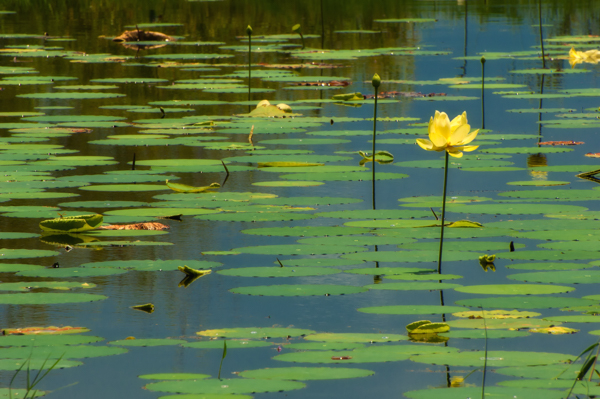
American Lotus on Lake Jackson
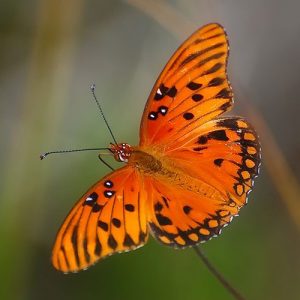
In an hour, I got quite a few good shots that I would consider “keepers” – an eastern tiger swallowtail butterfly feeding from the damp muck on the edge of the lake, good artistic shots of a silver-spotted skipper feeding on a giant sunflower, a bunch of wildflower images shot from ground level (I love this perspective), and this yellow American lotus – a freshly-opened flower among a floating carpet of lotus pads. I normally would have opted for my 50mm prime here and would have tried to get closer, but… I didn’t have it with me; I had to shoot from a distance and try a different style of composition, and it worked out beautifully!
Lotus plants have always intrigued me since the days I worked summers in a plant nursery in SW Florida many years ago. Often confused with waterlilies, the lotus is significantly larger – both the flower and the pads. The large and delightfully beautiful flower can reach a couple feet or more above the surface of the water in which it grows, and has the most interesting and strange seedpods that I’ve ever seen in any aquatic plant. Every summer I can’t wait to get out on the lake – not only for nature photography (and fishing), but for playing with the lotus pads. They are fascinating! If you put a bit of water on top of them, the water will bead like mercury, and the pads will not get wet, even though they grow and float on the surface of the lake. Push the whole pad underwater, it will pop back up dry! This strange phenomenon, actually called “the lotus effect” is caused by a complex multi-layer of wax that keeps the plant healthy by repelling water, organic particles and soil from sticking to the leaves, which is then easily cleaned by wind and rain. Next time you stop by a plant nursery that has an aquatic plant area, splash some water on the pads and see for yourself!
Sharing and commenting via the social media links below will help me greatly, and is much appreciated.
Thank you in advance!
ALL IMAGES AVAILABLE FOR PRINT OR DIGITAL DOWNLOAD!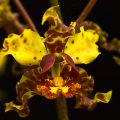
Absolutely gorgeous photo!
Interesting to hear the ideology behind taking shots with the tools at hand – sounds like a good process to me. Plus, it’ a tip for those starting out, who may have limited gear – you arent limited in your thinking….
Your enthusiasm always comes through in your writing Rich, I particularly liked what you had to say about what using your bike vs. walking means, plus the thoughts on the lotus. Great share.
Sometimes I just walk around shooting with an 18-55mm and a reverse lens mount for macros. Of course I curse when I need a long lens for a butterfly or something but, I make do.
This is so beautiful! These and water lilies are my favorite flowers. I guess I’m just a swamp girl. =)
I hear you! I’ve got the swamp in my blood too! 🙂 Thank you!